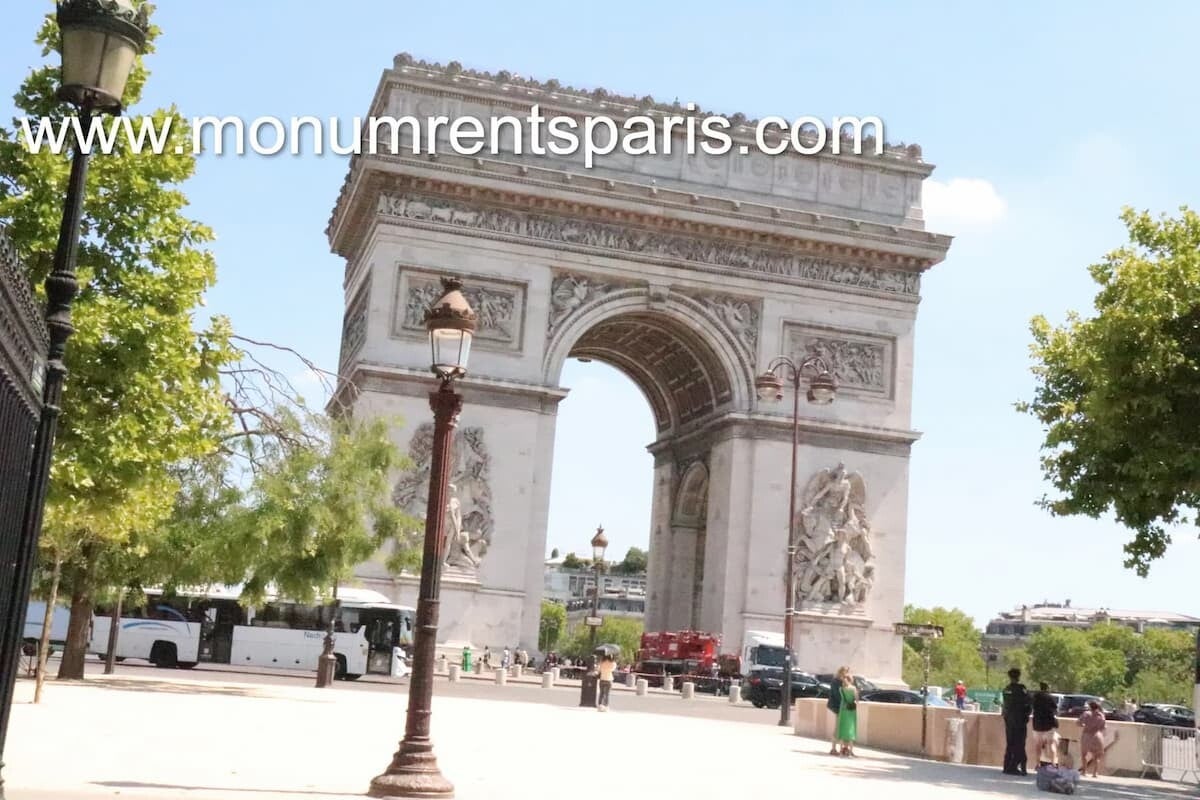
Arc de Triomphe, Paris
Commissioned by Napoleon in 1806, the Arc de Triomphe is one of the most iconic monuments in the world. Standing at the heart of the Place Charles de Gaulle, at the western end of the Champs-Élysées, it honours the soldiers who fought and died for France during the French Revolutionary and Napoleonic Wars. Today it offers one of the most breathtaking 360-degree views of Paris — perfectly aligned with the Eiffel Tower, the Louvre, and the Grande Arche de la Défense along the city's historic axis.
History
Napoleon Bonaparte commissioned the Arc de Triomphe on 18 February 1806, following his great victory at the Battle of Austerlitz. Designed by architect Jean Chalgrin in the neoclassical style, the arch took 30 years to complete and was finally inaugurated in 1836 — fifteen years after Napoleon's death.
The arch stands 50 metres high and 45 metres wide, making it one of the largest triumphal arches in the world. Its four faces are decorated with enormous sculptural reliefs, the most celebrated of which is La Marseillaise by François Rude — a dynamic depiction of volunteers departing for war in 1792, considered one of the masterpieces of French sculpture.
At the base of the arch lies the Tomb of the Unknown Soldier, added in 1921 to honour the unidentified French soldiers who died in the First World War. The Flame of Remembrance is rekindled here every evening at 6:30pm — one of the most moving ceremonies in Paris.
The View from the Top
Standing at the top of the Arc de Triomphe, 50 metres above the Place Charles de Gaulle, you are rewarded with one of the finest panoramic views in Paris. Twelve great avenues radiate outwards from the arch like the spokes of a wheel — including the Champs-Élysées stretching east towards the Louvre, and the Avenue de la Grande Armée running west towards La Défense.
At sunset, the view is at its most spectacular — the Eiffel Tower sparkling to the south-west, the golden light falling along the Champs-Élysées, and the great axis of Paris laid out before you in its entirety.
The Tomb of the Unknown Soldier
At the base of the arch, beneath the vault, lies the Tomb of the Unknown Soldier — the burial place of an unidentified French soldier killed during the First World War. The eternal Flame of Remembrance burns above the tomb and is rekindled every evening at 6:30pm in a ceremony that has taken place without interruption since 11 November 1923.
Opening Hours
April – September : 10:00am – 11:00pm daily
October – March : 10:00am – 10:30pm daily
Closed : 1 January, 1 May, 8 May (morning), 14 July (morning), 11 November (morning), 25 December
Last entry : 45 minutes before closing
Ticket Prices
Full price : €13
Reduced : €10 (18–25 year olds from outside the EU)
Free : Under 18s | EU residents under 26 | First Sunday of the month (November–March)
Book your skip-the-line tickets : (lien GetYourGuide)
Getting There
Address : Place Charles de Gaulle, 75008 Paris
Metro : Charles de Gaulle – Étoile (lines 1, 2, 6)
RER : Charles de Gaulle – Étoile (line A)
Important : Always use the underground pedestrian walkway (Passage du Souvenir) to reach the arch — never try to cross the traffic circle on foot!
FAQ
How many steps to the top?
There are 284 steps to the top of the Arc de Triomphe. An elevator is available but strictly reserved for visitors with reduced mobility.
When is the best time to visit?
Sunset is the best time — the 12 avenues radiating from the arch are at their most beautiful in the golden evening light, and the Eiffel Tower begins its light show after dark.
Where is the Tomb of the Unknown Soldier?
At the base of the arch, under the vault. The Flame of Remembrance is rekindled every evening at 6:30pm — arrive a few minutes early to watch the ceremony.
Is it worth going to the top?
Absolutely — the 360-degree view of Paris from the rooftop terrace is one of the finest in the city, and very different from the view from the Eiffel Tower.