Notre-Dame Cathedral Paris: History, Architecture & Visitor Guide 2026
Notre-Dame Cathedral is without question the most visited monument in Paris — and one of the most recognisable buildings in the entire world. Standing on the Île de la Cité in the heart of the Seine, this magnificent Gothic masterpiece has watched over Paris for more than 850 years, surviving revolutions, wars, and near-destruction. After the devastating fire of April 2019, Notre-Dame has risen from the ashes and reopened its doors to the world on 7 December 2024 — more beautiful and more moving than ever. This complete guide tells you everything you need to know before you visit.
Notre-Dame Paris Reopening: December 2024
On 7 and 8 December 2024 — exactly five years and eight months after the catastrophic fire of April 15, 2019 — Notre-Dame Cathedral officially reopened its doors to the public. The reopening was an emotional and historic moment for France and for the world, celebrated with a series of ceremonies attended by world leaders, dignitaries, and thousands of Parisians who had mourned the damage to their beloved cathedral.
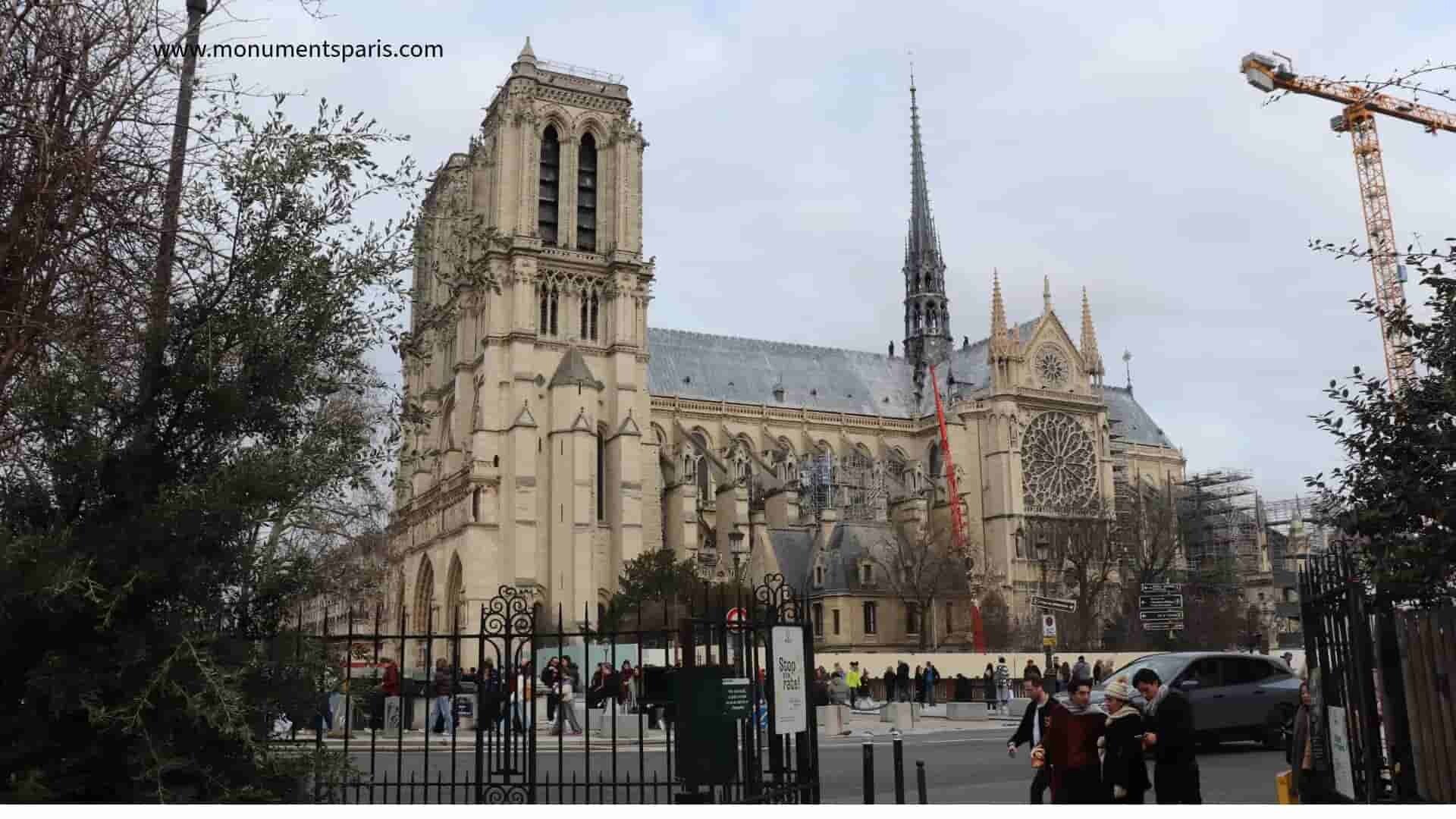
The restoration was one of the most ambitious and complex heritage projects in modern history. Over 2,000 craftspeople, artisans, architects, and specialists from across France and the world worked tirelessly to restore Notre-Dame to its former glory. The new spire, rebuilt using traditional methods with oak timber and topped with a gilded cockerel, was re-erected in 2023 and now once again crowns the Parisian skyline.
Note: While the cathedral has reopened for visits and worship, some restoration work on the exterior continues. Visitors can now enter the cathedral fully and admire its restored interior, including the magnificent nave, the rose windows, and the newly restored chapels
The History of Notre-Dame Cathedral
Construction: A Medieval Marvel
Construction of Notre-Dame began in 1163 under Bishop Maurice de Sully and King Louis VII of France. Built on the site of an earlier Romanesque church, the cathedral took nearly 200 years to complete, with the main structure finished around 1345. It was one of the first buildings in the world to use flying buttresses — the elegant external arches that support the walls and allow for the cathedral's soaring height and large stained glass windows.
Notre-Dame Through the Centuries
1239: King Louis IX brought the Crown of Thorns to Notre-Dame, where it is still kept today.
1302: The first meeting of the Estates-General of France was held at Notre-Dame.
1431: Henry VI of England was crowned King of France at Notre-Dame during the Hundred Years' War.
1594: Henry IV attended a Te Deum at Notre-Dame to celebrate his entry into Paris.
1804: Napoleon Bonaparte crowned himself Emperor of the French at Notre-Dame in a lavish ceremony.
1944: A Te Deum was sung at Notre-Dame to celebrate the Liberation of Paris from Nazi occupation.
2019: A devastating fire destroyed the spire and the roof. The world watched in shock as the cathedral burned.
2024: Notre-Dame reopened after five years of extraordinary restoration work.
The Fire of April 2019: A Night the World Will Never Forget
On the evening of Monday 15 April 2019, a fire broke out in the attic of Notre-Dame Cathedral during renovation work. Within minutes, the blaze had spread to the medieval oak roof structure — known as "the Forest" because of the 1,300 ancient oak trees used in its construction. At 7:50 PM, the cathedral's iconic 93-metre spire collapsed in a shower of sparks before the eyes of hundreds of thousands of people watching in disbelief.
Incredibly, thanks to the heroic efforts of over 400 firefighters who worked through the night, the two bell towers, the main structure, and many of the cathedral's most precious treasures were saved. Among the objects rescued were the Crown of Thorns, the tunic of Saint Louis, and numerous irreplaceable works of art. The rose windows miraculously survived almost intact.
In the days following the fire, donations poured in from around the world. Within a week, over one billion euros had been pledged for the restoration.
The Architecture of Notre-Dame: What to Look For
The West Façade
The main entrance features three elaborately carved portals — the Portal of the Virgin, the Portal of the Last Judgement, and the Portal of Saint Anne. Above the portals runs the Gallery of Kings, featuring 28 statues of the Kings of Judah. Above that, the magnificent 13-metre rose window and the twin towers, which rise to 69 metres.
The Rose Windows
Notre-Dame has three extraordinary rose windows — on the west, north, and south façades. Dating from the 13th century, these circular stained glass masterpieces are among the finest examples of medieval art in existence. The north rose window, measuring nearly 13 metres in diameter, is considered particularly exceptional.
The Flying Buttresses
Walk around to the east end of the cathedral for the best view of the flying buttresses — the elegant external arches that are both structural and decorative. Notre-Dame was one of the first Gothic buildings to use this revolutionary technique.
The Gargoyles and Chimeras
The famous gargoyles and chimeras that peer out from Notre-Dame's towers are one of its most iconic features. The most famous is the Stryge, a winged demon resting its chin on its hands and gazing thoughtfully over Paris.
The Organ
Notre-Dame houses one of the largest pipe organs in the world, with nearly 8,000 pipes. Miraculously surviving the 2019 fire, the Grand Organ was fully restored and played again for the first time at the December 2024 reopening ceremony.
Practical Information for Visiting Notre-Dame in 2026
Opening Hours
Monday to Friday: 8:00 AM – 6:45 PM
Saturday & Sunday: 8:00 AM – 7:15 PM
Hours may vary on religious holidays
Admission
Entry to the cathedral is free. Tower visits require a paid ticket — book online in advance to avoid queues.
How to Get There
Metro Line 4 – Cité station
RER B & C – Saint-Michel Notre-Dame station
Bus: Lines 21, 38, 47, 85, 96
Tips for Visiting Notre-Dame Cathedral
Arrive early — queues can be very long by mid-morning
Visit on a weekday for a quieter experience
Walk around the entire exterior before entering
Find the small brass star on the square in front — it marks Point Zéro, the point from which all distances in France are measured
Visit Square Jean XXIII behind the cathedral for the best views of the flying buttresses
Combine with Sainte-Chapelle and the Conciergerie — all three are on the Île de la Cité
Why Notre-Dame Cathedral is the Heart of Paris
Notre-Dame de Paris is more than a cathedral — it is the spiritual, historical, and geographical heart of France. Every kilometre in the country is measured from the small brass star set into the pavement in front of it. It has inspired poets, novelists, and artists for centuries — most famously Victor Hugo, whose 1831 novel transformed the cathedral into a global cultural icon.
The fire of 2019 was a tragedy that united the world in grief. But the extraordinary restoration that followed has given Notre-Dame a new chapter in its 850-year story. Visiting Notre-Dame today is witnessing one of the greatest acts of cultural restoration in human history.
Whether you are visiting Paris for the first time or returning after many years, a visit to Notre-Dame Cathedral is an experience that will stay with you forever.