Louis XIV: Complete Guide to the Sun King of France
In the long and extraordinary history of France, no figure casts a longer shadow than Louis XIV — Le Roi Soleil, the Sun King. Reigning for 72 years from 1643 to 1715 — the longest reign of any major monarch in European history — Louis XIV transformed France from a kingdom torn by civil war and noble rebellion into the most powerful, most admired, and most imitated nation in Europe. He built the Palace of Versailles, invented absolute monarchy, created the French classical style in art and architecture, made French the language of European diplomacy, and established a model of royal power that monarchs across the continent spent the next century trying to copy. More than 300 years after his death, Louis XIV remains the defining figure of French history — the king against whom all others are measured
The Life of Louis XIV
Birth and Childhood — The Gift of God
Louis XIV was born on 5 September 1638 at the Château de Saint-Germain-en-Laye, the son of King Louis XIII and his queen, Anne of Austria. His birth was considered nothing short of miraculous — his parents had been married for 23 years without producing an heir, and the birth of a healthy son after so long was greeted with extraordinary joy throughout France. The infant king was immediately given the nickname "Dieudonné" — the Gift of God.
His father died when Louis was just four years old, leaving France in the hands of his mother Anne as regent and her chief minister, the Italian Cardinal Jules Mazarin. The young king's childhood was marked by the trauma of the Fronde — a series of civil wars between 1648 and 1653 in which the great nobles of France rose up against royal authority, forcing the young king and his mother to flee Paris in the middle of the night on several occasions..
The experience of the Fronde left a permanent mark on Louis XIV. He developed a lifelong distrust of the Parisian crowds and an absolute determination to break the power of the nobility — lessons that would shape his entire reign.
The Young King — Early Reign
Louis XIV became king at the age of four but did not take personal control of the government until 1661, following the death of Cardinal Mazarin. He was twenty-two years old. At his first council meeting after Mazarin's death, his ministers asked to whom they should address themselves for instructions. Louis replied simply — "To me."
From that moment, Louis XIV governed France personally, without a chief minister, for over fifty years. He worked for hours every day — reading dispatches, receiving ambassadors, presiding over councils — with a discipline and dedication that astonished his contemporaries. "L'état, c'est moi" — "I am the state" — whether or not he actually said these precise words, the sentiment perfectly captures his conception of royal power.
Love and Marriage
Louis XIV's personal life was as spectacular as his public career. He married the Spanish Infanta Maria Theresa in 1660 — a political marriage arranged to seal the Treaty of the Pyrenees between France and Spain. The queen was devoted to her husband but had little influence over him — Louis was notoriously unfaithful throughout their marriage.
His great loves were his mistresses — the women who had real influence over him and who shaped the cultural life of Versailles. The most important were:
Louise de La Vallière — the first great royal mistress, gentle and devoted, who bore Louis four children before retiring to a convent
Françoise-Athénaïs de Montespan — the most powerful of all Louis's mistresses, brilliant, witty, and ambitious, who dominated the court for over a decade and bore the king seven children
Françoise d'Aubigné, Madame de Maintenon — the governess of Montespan's children who became the king's last great love and, after the queen's death in 1683, his secret wife
The Wars of Louis XIV
Louis XIV was above all a warrior king — a monarch who defined his glory through military conquest and who spent much of his reign at war. His armies were the finest in Europe, reformed and professionalised by the great military genius the Marquis de Louvois and led by the legendary marshals Turenne and Condé.
His major wars included:
The War of Devolution (1667-1668) — Louis's first war, fought to claim territories in the Spanish Netherlands through his wife's inheritance rights. France gained several Flemish towns including Lille.
The Franco-Dutch War (1672-1678) — the most successful of Louis's wars, in which French armies overran much of the Dutch Republic. France gained the Franche-Comté and further Flemish territories.
The War of the League of Augsburg (1688-1697) — a defensive war against a coalition of almost all the major European powers, which ended inconclusively and strained French resources enormously.
The War of the Spanish Succession (1701-1714) — the last and greatest of Louis's wars, fought to place his grandson Philip on the Spanish throne. It ended with the Treaty of Utrecht, which confirmed Philip as King of Spain but forced France to make significant territorial concessions
The Revocation of the Edict of Nantes
One of the most controversial acts of Louis XIV's reign was the Revocation of the Edict of Nantes in 1685 — the decree by which his grandfather Henri IV had guaranteed religious freedom to French Protestants (the Huguenots) in 1598. Louis's revocation forced over 200,000 Huguenots — many of them skilled craftsmen, merchants, and intellectuals — to flee France for England, the Dutch Republic, Prussia, and other Protestant countries.
The revocation was motivated by Louis's sincere Catholic faith and his desire for religious uniformity within his kingdom — "Un roi, une loi, une foi" (one king, one law, one faith). Its consequences were catastrophic for France, depriving the country of much of its most productive population, and it was condemned by contemporaries and historians alike as one of the great blunders of his reign.
Louis XIV and Versailles
The Creation of Versailles
No achievement of Louis XIV is more celebrated — or more visited — than the Palace of Versailles. The transformation of his father's modest hunting lodge into the most magnificent palace in the world was the great project of Louis XIV's reign, consuming enormous resources and the talents of the greatest French architects, painters, sculptors, and landscape designers of the age.
Louis XIV moved his court permanently to Versailles in 1682, transforming the palace from a royal residence into the seat of French government. By housing the great nobles of France at Versailles — requiring their attendance at court as a condition of royal favour — he neutralised the threat they posed to royal authority. Nobles who spent their time competing for the honour of holding the king's candlestick at the lever ceremony had neither the time nor the inclination to plot rebellions in their provincial estates
The Arts at Versailles
Louis XIV was not merely the patron of the arts — he was their dictator. Under his reign, French art, architecture, music, literature, and theatre were organised, subsidised, and directed by the state to serve the glory of the king and France. The results were extraordinary — a flowering of French classical culture that produced some of the greatest works in Western history:
Jean-Baptiste Lully — the composer who created French opera and provided the music for the court ballets in which Louis himself danced
Jean-Baptiste Molière — the greatest comic playwright in French history, whose satirical comedies were performed at Versailles
Jean Racine — the supreme tragedian of French classical theatre
Charles Le Brun — the painter who decorated the Hall of Mirrors and the state apartments
André Le Nôtre — the landscape architect who created the gardens of Versailles.
Versailles as Political Theatre
At Versailles, every aspect of the king's daily life was transformed into a public spectacle — a political theatre in which the king played the starring role. The lever (the morning rising) and the coucher (the evening retirement) were elaborate ceremonies attended by hundreds of nobles, each of whom competed fiercely for the honour of performing some small service for the king.
The king ate his meals in public, walked in his gardens in public, attended Mass in public, and was seen by his subjects at every moment of the day. This extraordinary publicness was entirely deliberate — it was Louis XIV's way of making himself the constant centre of attention, the fixed point around which the entire universe of French court life revolved.
The Legacy of Louis XIV
France Under the Sun King
Under Louis XIV, France became the dominant power in Europe — politically, militarily, and culturally. French became the language of European diplomacy and aristocratic culture, replacing Latin as the universal language of educated Europeans. French fashion, French cooking, French architecture, and French literature set the standard for the entire continent. The Palace of Versailles was copied by dozens of European monarchs — from the Schönbrunn in Vienna to the Peterhof in Saint Petersburg — none of whom quite managed to equal the original.
The Dark Side of the Sun
Yet the Sun King's reign also had its dark side. The endless wars consumed enormous resources and left France exhausted and indebted by the end of his reign. The revocation of the Edict of Nantes drove away hundreds of thousands of productive citizens. The centralisation of power at Versailles weakened the institutions that might have reformed France, storing up the contradictions that would eventually explode in the Revolution of 1789.
Louis XIV died on 1 September 1715, at the age of 76, after a reign of 72 years and 110 days — the longest in French history. His great-grandson succeeded him as Louis XV, inheriting a kingdom whose glory masked a deepening crisis that would eventually destroy the monarchy his predecessor had made absolute.
Louis XIV's Influence on Paris
Beyond Versailles, Louis XIV left an extraordinary mark on Paris itself:
The Louvre — greatly expanded under Louis XIV, who commissioned the famous Colonnade by Claude Perrault
Les Invalides — built to house wounded soldiers of Louis's armies
Place Vendôme — created by Louis XIV to display an equestrian statue of himself
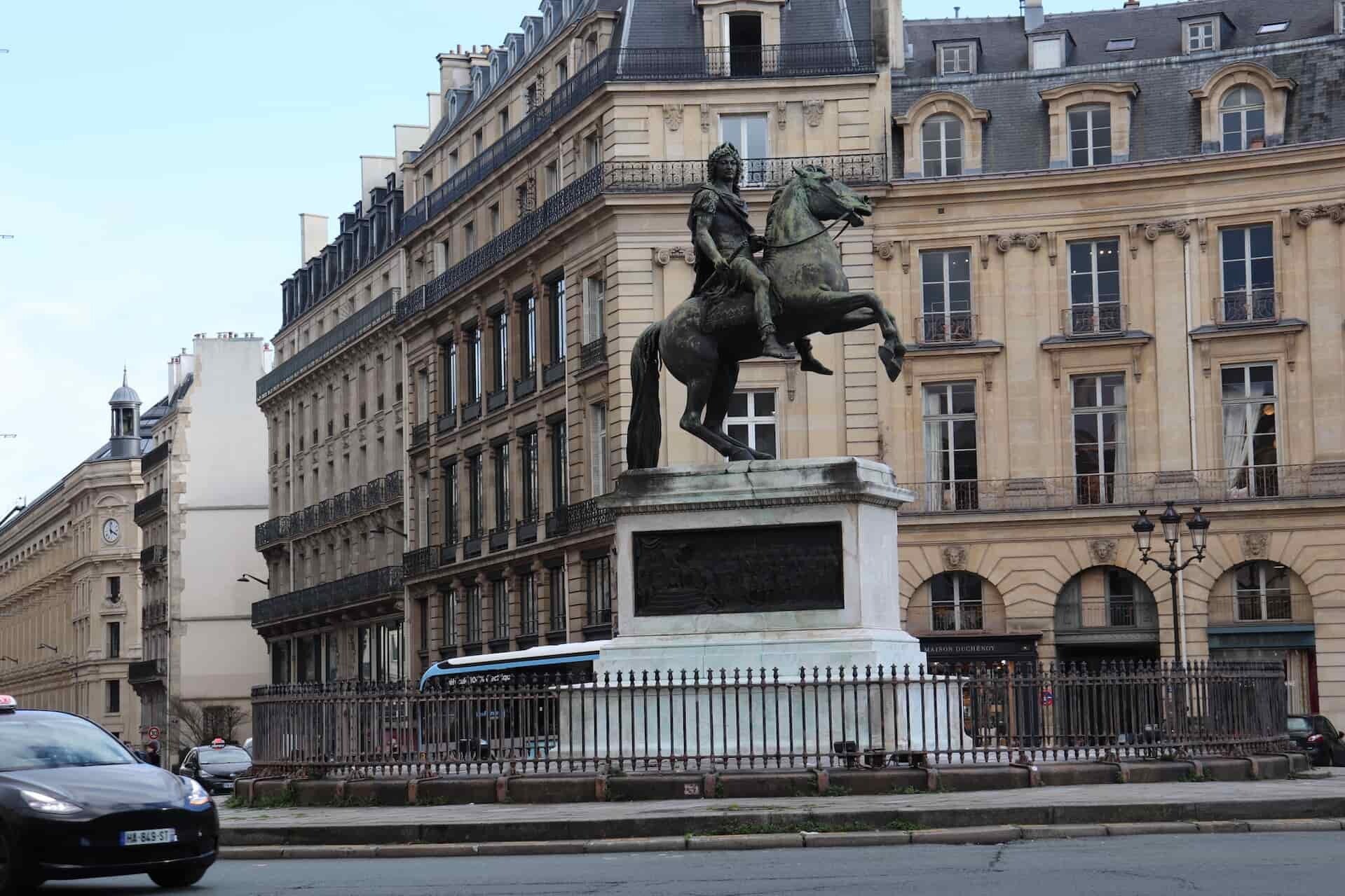
Place des Victoires — another royal square created to celebrate Louis's military victories
Porte Saint-Denis and Porte Saint-Martin — magnificent triumphal arches built to celebrate Louis's military campaigns
The Observatory of Paris — founded by Louis XIV in 1667
The Académie Française — reorganised and subsidised under Louis XIV
Where to See Louis XIV in Paris and Versailles Today
🏰 Palace of Versailles
His palace, the Hall of Mirrors, his bedchambe
🏛️ The Louvre
The Colonnade, the Apollo Gallery
⚔️ Les Invalides
His military legacy, the Army Museum
🏛️ Porte Saint-Denis
Triumphal arch celebrating his Rhine campaigns
Place Vendôme
Created by Louis XIV
🗿 Place des Victoires
Statue of Louis XIV at centre
Frequently Asked Questions about Louis XIV
How long did Louis XIV reign?
Louis XIV reigned for 72 years and 110 days — from 1643 to 1715 — making his the longest reign of any major monarch in European history.
Why is Louis XIV called the Sun King?
Louis XIV adopted the sun as his personal emblem early in his reign, associating himself with Apollo, the god of the sun, light, and the arts. The image of the sun — radiating light and warmth to all — perfectly captured his vision of himself as the centre of French life around whom everything else revolved.
Did Louis XIV really say "L'état, c'est moi"?
The phrase "L'état, c'est moi" — "I am the state" — is traditionally attributed to Louis XIV, but there is no contemporary evidence that he actually said it. The sentiment, however, accurately captures his philosophy of absolute monarchy
Where is Louis XIV buried?
Louis XIV is buried in the Basilica of Saint-Denis, just north of Paris — the traditional burial place of the kings of France.
What did Louis XIV build?
Louis XIV's greatest construction was the Palace of Versailles. In Paris, he was responsible for expanding the Louvre, building Les Invalides, creating the Places Vendôme and des Victoires, and commissioning the triumphal arches of the Porte Saint-Denis and Porte Saint-Martin.
How old was Louis XIV when he became king?
Louis XIV became King of France at the age of four, following the death of his father Louis XIII in 1643. He took personal control of the government in 1661, at the age of twenty-two, following the death of his chief minister Cardinal Mazarin.